THE FORTIFIED CASTELLO DI BAGNOLO: STRUCTURE AND LANDSCAPE
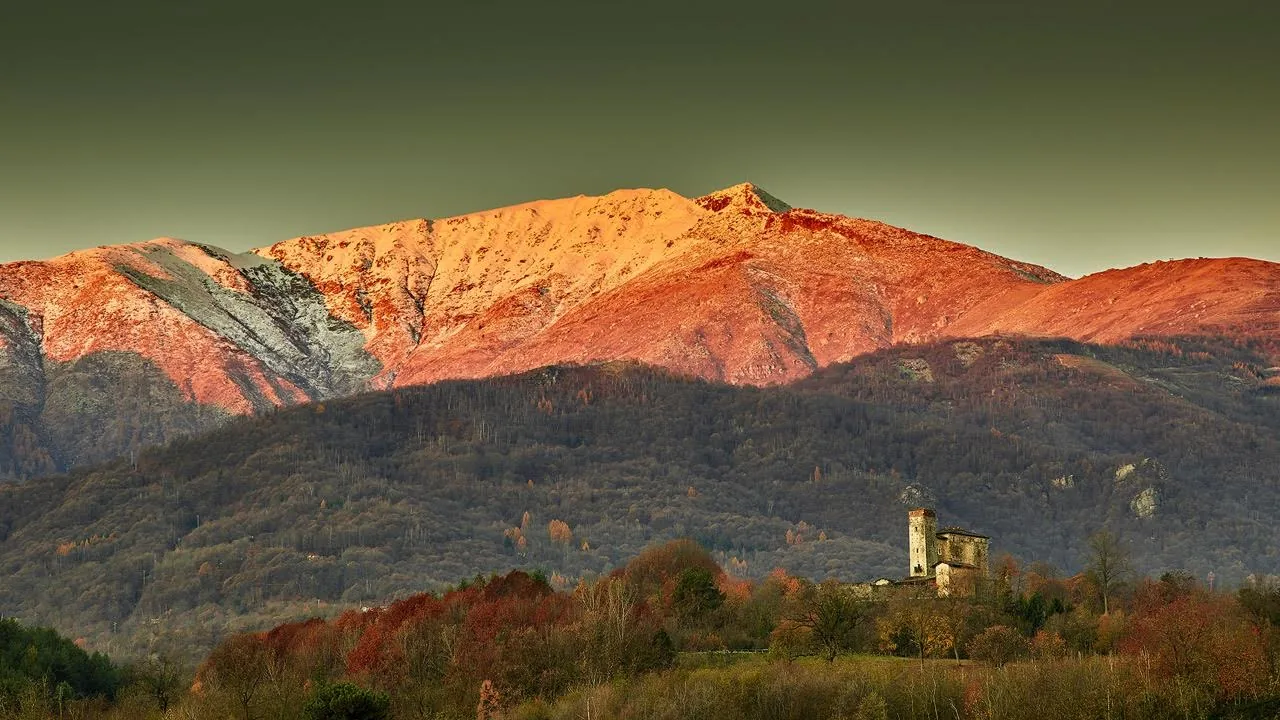
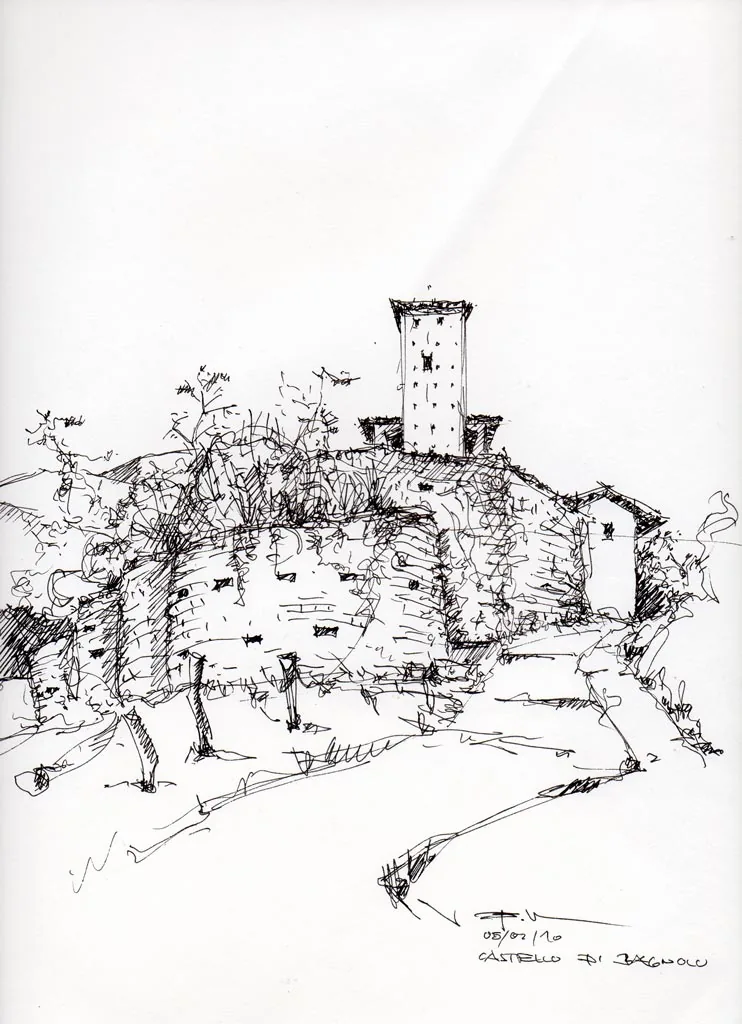
On the first mountain foothills, between the Pellice Valley and the Po Valley, in the early centuries after the year 1000 stood the fortified Castello di Bagnolo, surrounded by walls. Further down in the valley lay the “Castello Piano” and the old village of Bagnolo, in the state of the Dukes of Savoy, of which it was, in the Middle Ages, the south-western defence, in connection with the Rocca di Cavour.
The structure of the castle took shape over the first six centuries, then grew and was armed with ever new fortifications, according to the trends and needs of military architecture. At the beginning, around the year 1000, the keep (“mastio”) and the south tower were probably protected by a wooden palisade. In the following centuries a first circuit of stone walls was built, with Ghibelline battlements protecting the sentries’ walkway above, interspersed with small watchtowers. Then came the stair tower and the ravelin (“rivellino”), an embankment fortified by walls with four turrets and a round tower, which is today the “garden of the walls”, shaped like a ship’s prow. The advent of powerful firearms such as cannons, from 1330 onwards, demanded new defences: a second and then a third ring of walls were built, and the keep was reinforced all around its base with “barbacani” shaped like an elephant’s foot. The Ghibelline battlements crowned the upper floor; in later periods they were replaced by a covering of “lose” (stone slabs), as we see today.
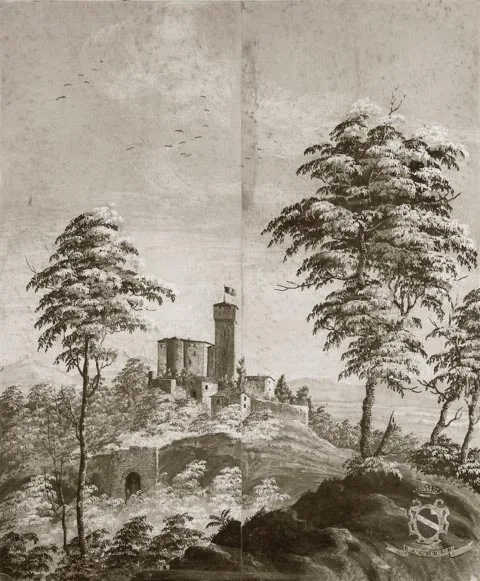
While the fortified Castle and the walls still preserve the early medieval character they had in the iconography of the 18th and 19th centuries, the traces of the old village have almost entirely disappeared. The “Castello Piano”, at the foot of the hill and until the 1400s part of the village, was transformed in the 17th and 18th centuries until it reached its present appearance, becoming the residence of the Counts Malingri and taking the name “Palazzo”. The “lose” roofs on wooden frames, and the character at once agricultural and representative, each contribute in their own way to welcoming the visitor and to making the whole a still-living testimony of military, rural and civil architecture from the Middle Ages to today.
The hilly farmland of the past (largely abandoned in the 1950s and 1960s), with reforestation and the enlargement of the existing woods (chestnuts, beeches, birches, conifers) interspersed with meadows, vineyards and orchards, has turned almost into a natural park, in which stand the CASCINE (farmhouses, with their wells, bread ovens and stables) and the WATER MILLS (those of the blacksmith, the carpenter and the miller still remain), which were part of the fief of Count Malingri di Bagnolo, loyal feudatory of the Savoys. Almost all of these stone buildings with stone-slab roofs, built in various periods, have been recovered and carefully restored, keeping their character, their equipment and, where possible, their original uses.
Today the property belongs to Baron Aimaro Oreglia d’Isola, architect, son of Caterina Malingri di Bagnolo, the last direct descendant of the Malingri di Bagnolo. For eight centuries the feudal complex with the Palazzo, the park and the Castle has been defended, maintained, cared for and lived in without interruption by the same family, which, despite many difficulties, has sought to preserve its architecture, art, history and landscape.
HISTORY
Drawn from notes written around 1920 by Count and General Aimaro Malingri di Bagnolo on the basis of archive documents, these brief notes give an overview of the main historical events involving the fief, the village of Bagnolo, the Castle and the Palazzo.
The history of the Palazzo and the Castle is largely tied to that of the village which, populous at the time, had stood since ancient times at the foot of the Castle that protected it, in the meadows below called Pradoni or Prati Cesarei, strongly defended by the stream and by palisades and ditches, where the Palazzo of the Malingri family still stands today, and perhaps the old parish church.
The village of Bagnolo was destroyed in 1219 by the people of Vercelli, and the Dukes of Savoy decided (on 31 March 1293) to move it down to the plain, “in planum revertamur”, near the convent of S. Pietro. That agreement even set the place where the administrators of the community were to assemble.
But the agreement was not carried out, because of the natural reluctance of the men of Bagnolo to go down to the plain, which was considered unsafe in those troubled times of continual devastating wars, as it was not protected by the strong castle. Proof of this is an ordinance of 29 October 1338 by Giacomo di Acaja ordering once again the move to S. Pietro.
In the 11th, 12th, 13th and 14th centuries, under the high sovereignty of the House of Savoy by inheritance from Countess Adelaide di Susa, various lords held fiefs in this area, taking their name from the land itself, and were gradually absorbed by greater vassals such as the Lucerna, the Orsini di Rivara, the Provana, the Albertenghi and the Della Torre.
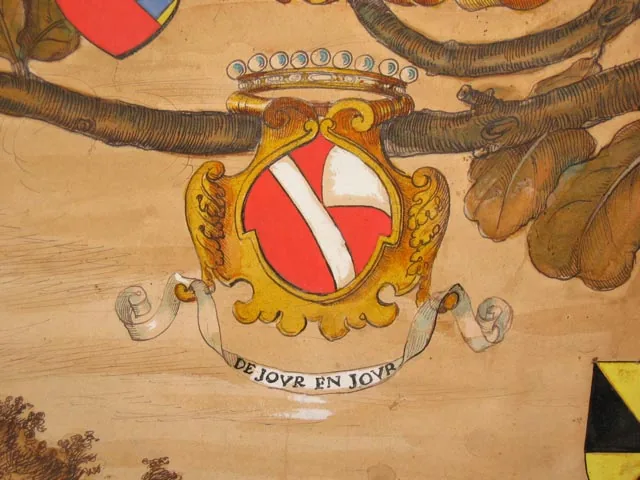
In 1412 Amedeo Malingri, lord of Saint Genix, squire and ambassador of Duke Amedeo VIII and a well-known Occitan poet, was invested with the fief by Ludovico, Prince of Acaja, and confirmed by Emperor Sigismund at Konstanz on 14 September 1415. In 1702 the fief was raised to a county in favour of the Malingri family.
In the 16th century the plague depopulated Bagnolo.
In the war over the lordship of the Marquisate of Saluzzo, in the 16th century, Francis I of France devastated Bagnolo. When peace was made, the border between the French dominion of Saluzzo and the lands of the Savoys, to whom Bagnolo always remained loyal, was set there: the Torre Cairà (locality S. Grato) and other towers, now in ruins, protected by ditches and trenches and leaning on the then formidable fortress of Cavour and on the Castello di Bagnolo, still mark the old border between France and Savoy.
At the end of the 1500s, in the wars between Henry IV and Charles Emmanuel I, Marshal Lesdiguières sacked Bagnolo, killing a large part of the inhabitants and capturing the Castle, which was dismantled and largely torn down. At the beginning of the 17th century Marshal Catinat, after destroying Cavour, sacked Bagnolo but could not take the Castle, which was ably defended with advanced methods and artillery.
In the 17th century the Waldensians, having set fire to Fenile and Campiglione, attempted a surprise attack on Bagnolo but were repulsed with heavy losses. Later, to conclude a peace treaty with the Savoys, the Waldensians asked for and obtained the head of Gian Bartolomeo Malingri di Bagnolo, who had fought and won bloody battles against them.
In 1690, after the defeat at Staffarda, Duke Vittorio Amedeo II, pursued by the French cavalry, took refuge under the protection of the Castle and stopped in its redoubt, the Castellino. A stone plaque on the well of the Castlin farmhouse commemorates this event.
In 1797 French revolutionary troops occupied Bagnolo, but in 1799 they were driven out by General Kutusoff (the war hero of Tolstoy’s War and Peace), who annihilated them at Bibiana.
Over 150 years of peace followed for the Castle, but the hardest of wars began in 1943.
THE RESISTANCE (“LA RESISTENZA”)
In the 19th and 20th centuries, the changes and historical events that led the Savoys to become Kings of a large unified country effectively cancelled the importance of the Castle’s military position. No longer inhabited by soldiers and weapons, it slowly fell into decay. For over a century it was lived in by farmers and shepherds, treated as one of the farmhouses of the fief and used as such. Yet it was precisely in this last period of its history that the castle lived through its bloodiest and hardest-fought season of war and fire.
From 1943 to 1945, at the end of the Second World War, the area from the Palazzo to the Castle and up into the mountains was the scene of the struggle between anti-fascist partisans and Italian fascists allied with the retreating German army. Caterina Malingri di Bagnolo and her husband, Baron Vittorio Oreglia d’Isola, together with their guests, relatives, friends, servants and their two children Aimaro and Leletta, sided with the partisans, whom they helped, treated and protected during the 20 very long months of the struggle for liberation. The Infernotto valley, Barge, Paesana, the Po valley and the neighbouring valleys were the battlefield of the Garibaldi Division in Piedmont, supported also and above all by the heroic participation of the civilian population, who paid for this choice with much blood and many lives.
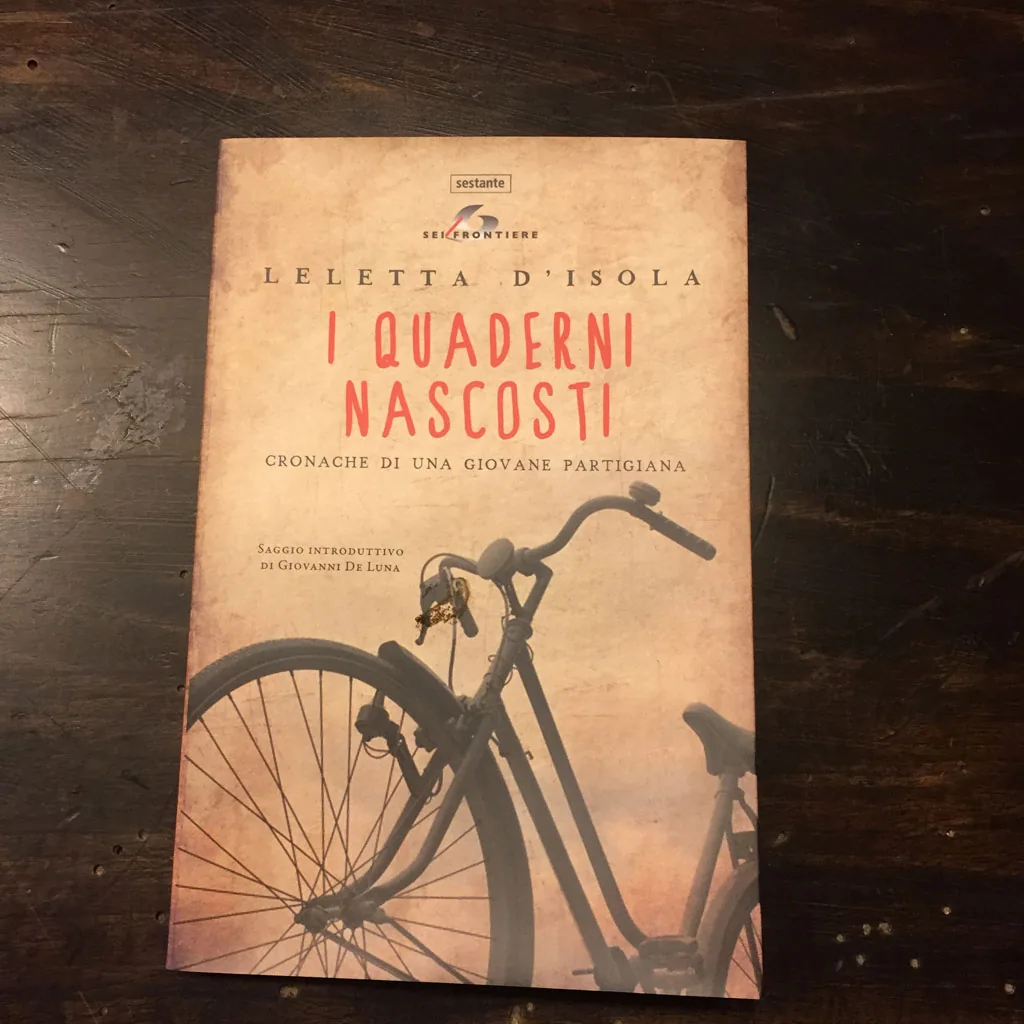
The Palazzo and the Castle stood at the centre of this territory and of this war: they often served as a means of communication, support and hiding place for the partisans. The events of this period are told in the fresh voice of the very young Leletta in her diary, which has become a document and a living testimony of the history of the Italian Resistance.
LELETTA ISOLA AND HER DIARY
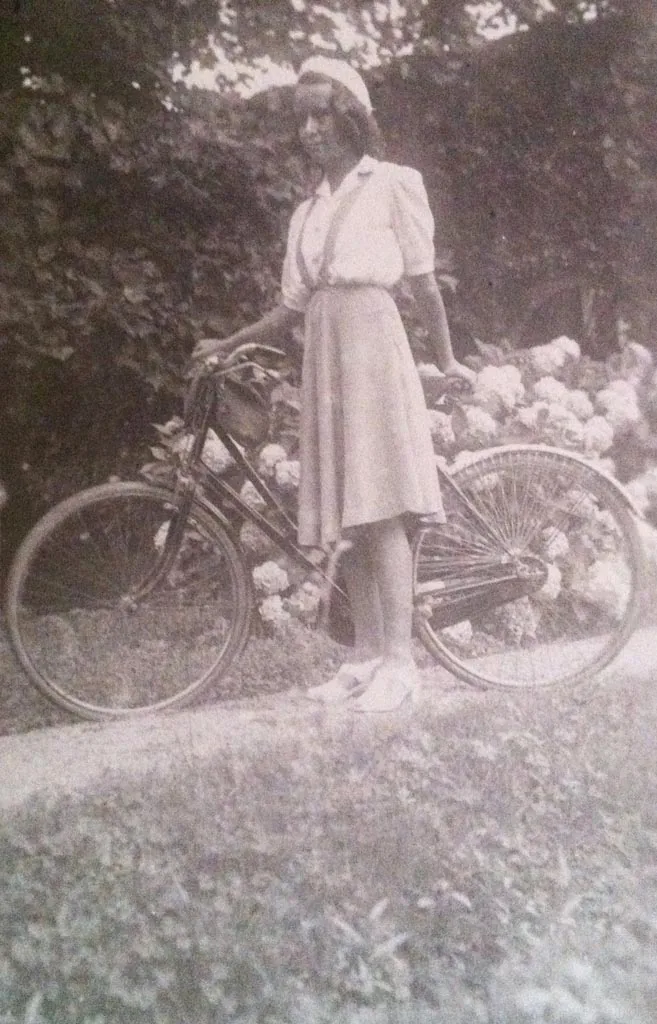
Seventeen years old, a high-school student and a fervent Catholic, Leletta finds herself living through an experience she senses to be “historic”, and records it day by day in her diary notebooks, which she keeps hidden and fills in when she can, for fear they might be discovered by the enemy (raids and searches by the Germans were frequent). Her words reflect the gaze of a girl facing the horrors of war with the light-heartedness of her young years, but also with the clarity that comes from a courageous and conscious faith.
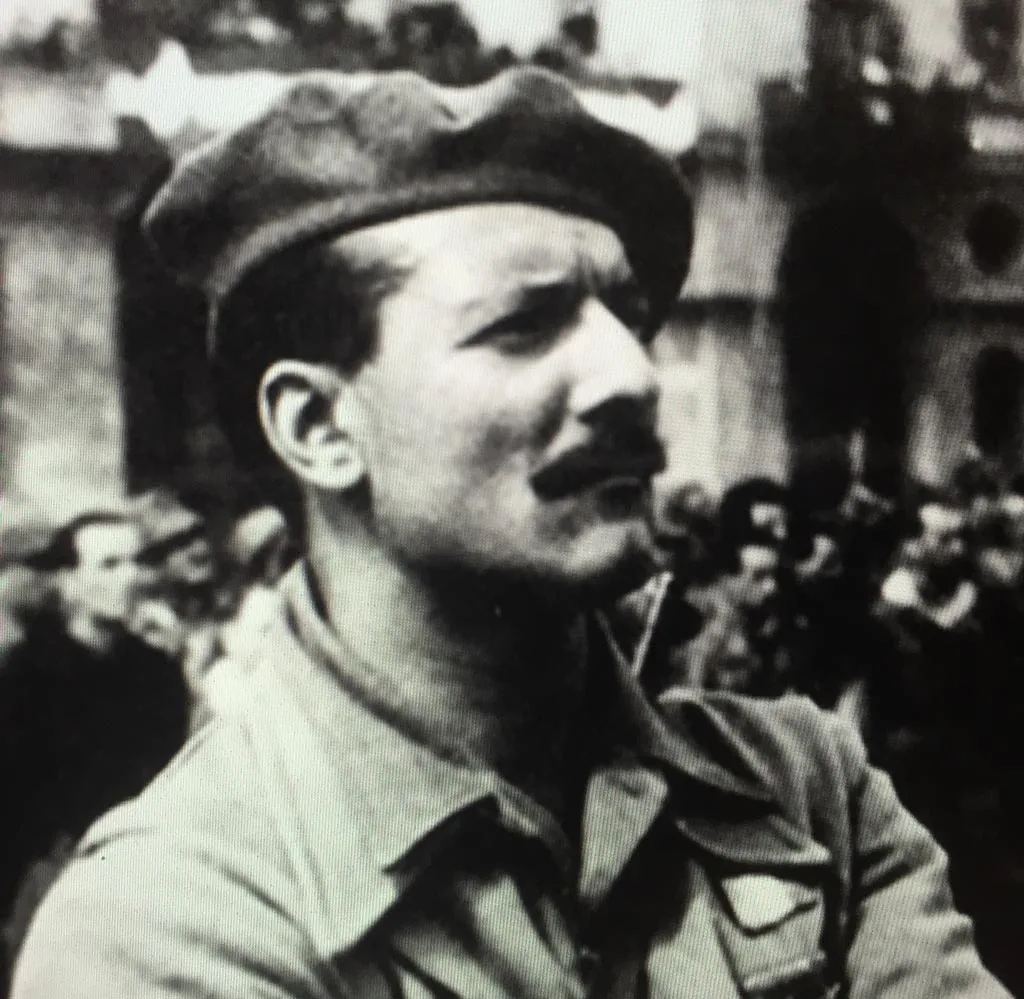
What made her testimony precious was also the fact that, in her own house, in the courtyard and in the castle, the communist partisans of the Garibaldi Brigade were hosted and took refuge, in particular their leader, Commander Barbato, nom de guerre of Pompeo Colajanni, a Sicilian cavalry officer who joined the fight against the fascists after 8 September 1943. Already on 10 September, in Barge, he gathered officers, NCOs and soldiers and formed the first nucleus of armed resistance: enthusiastic and a born leader, cultured and militarily trained, Colajanni then led his men into the mountains, not to hide but to fight a war that proved long and hard, but had exhilarating and glorious moments.
Leletta was fascinated by the commander, but between the lines of the diary her admiration was always seasoned with a pinch of mischievous irony. The Catholic noblewoman and the communist partisan!
Leletta and Commander Barbato were not a “historic compromise” ahead of its time: the Garibaldi partisans were not fighting in the mountains of Villar to establish the dictatorship of the proletariat, nor did the aristocratic, monarchist family see them as future enemies, but as men fighting for their very own values. This is the reality that the pages of Leletta’s diary give back to us.